Corrugated Box Price in Noida & Delhi NCR (2026): What Actually Decides Your Cost — And How to Get a Fair Quote
Corrugated Box Price in Noida & Delhi NCR (2026): What Actually Decides Your Cost — And How to Get a Fair Quote
By Nirmal Packaging Industries | Est. 2011 | C-192, Sec-10, Noida | Corrugated Box Manufacturer & Supplier
If you’ve spent even a day calling around for box quotes in Noida, Ghaziabad, Gurugram or Faridabad, you already know the problem: every supplier gives you a different number for what sounds like the exact same box. One quotes ₹18 a piece, another quotes ₹26, and a third just says “depends, send your requirement on WhatsApp.”
None of them are lying to you. Corrugated box pricing genuinely isn’t a fixed number — it moves with paper rates, ply, size, print, and even how far the courier has to travel from the factory to your warehouse. The problem isn’t that pricing is unfair. It’s that nobody explains why the number changes, so buyers end up either overpaying out of confusion or underpaying with a supplier who cuts corners on ply strength to hit a low rate.
This guide breaks down exactly what goes into a corrugated box price in the NCR market right now, what a fair quote actually looks like, and the questions you should be asking before you place a bulk order — whether you’re a D2C brand in Noida, an FMCG unit in Faridabad, or a trader in Delhi’s Sadar Bazaar.
Why Corrugated Box Price Isn’t a Fixed Number
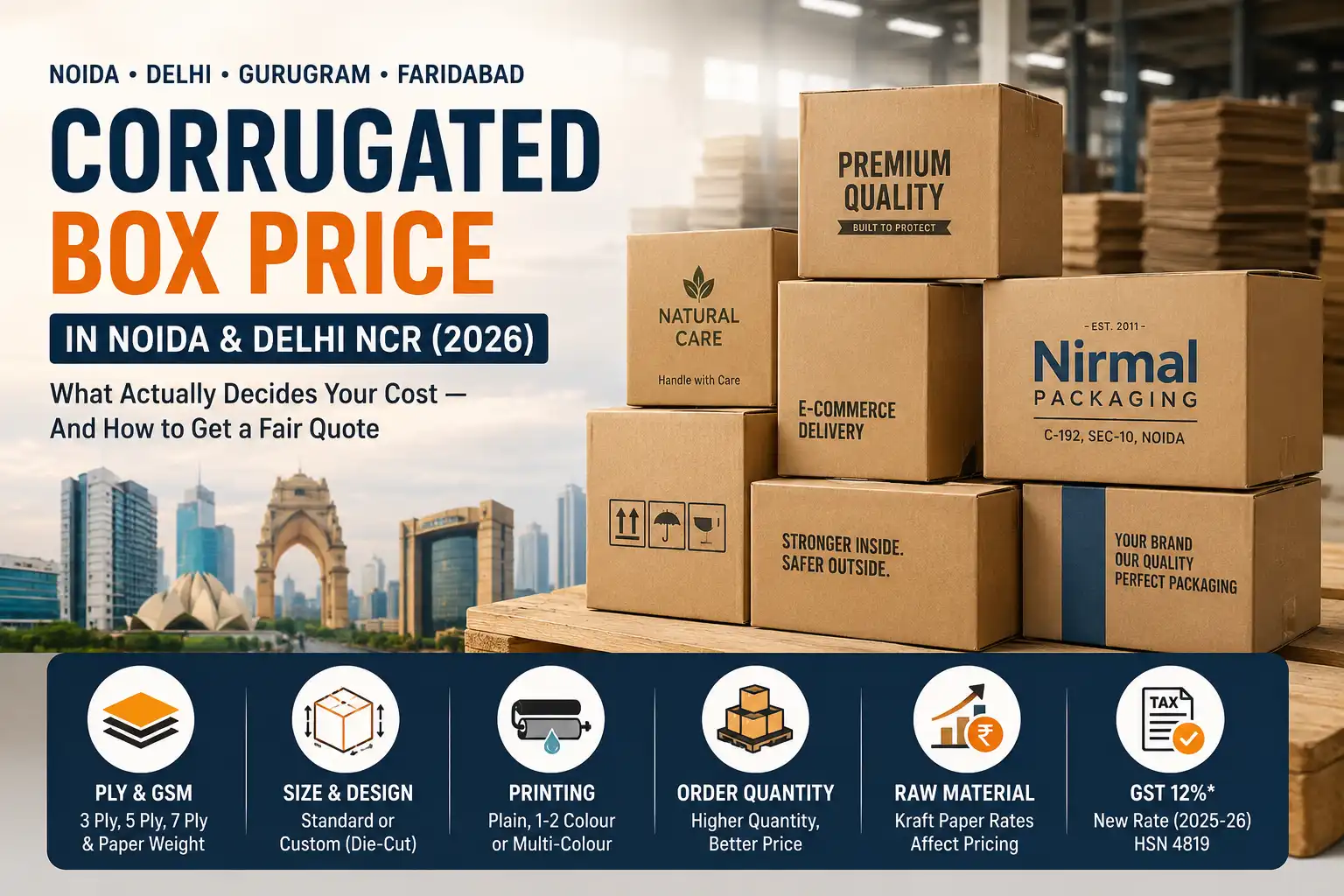
A corrugated box is essentially engineered paper. Its cost is built from six variables stacking on top of each other, and changing even one of them shifts the final price meaningfully.
1. Ply — 3 ply, 5 ply, or 7 ply More layers mean more paper, more strength, and a higher price. A 3-ply box for light, non-fragile items will always cost less than a 5-ply box built for heavier goods or long-distance shipping. If you’re unsure which one your product needs, we’ve written a separate guide comparing 3 ply vs 5 ply corrugated boxes in more detail.
2. GSM (paper weight) GSM stands for grams per square metre — basically how dense and strong the paper is. A box made from 100 GSM kraft paper will always be cheaper and weaker than one made from 150 or 200 GSM paper. Some suppliers quote a “cheap” price by quietly dropping GSM, and the box looks fine until it’s stacked five high in a warehouse.
3. Box size and design (die-cut vs standard) Standard-size boxes made from existing dies are cheaper because there’s no tooling cost. Custom sizes or unusual shapes need a new die to be cut, which adds a one-time cost — usually recovered over your order volume.
4. Printing—plain, single-color, or multi-colour A plain kraft box with no branding is the cheapest option. Flexographic printing (1-2 colors) adds a moderate cost. Offset printing or lamination for premium, retail-facing boxes costs more but looks significantly better on a shelf or in an unboxing video.
5. Order quantity This is the single biggest lever on per-piece price. Corrugation is a volume business — running the machine for 500 boxes costs almost the same as running it for 2,000, so the per-piece price drops sharply as quantity goes up. This is exactly why many new brands unknowingly overpay in their first order; we cover this pattern in our guide on packaging for startups and small D2C brands.
6. Raw paper (kraft) rates Kraft paper prices fluctuate through the year based on pulp costs and demand. When paper rates go up nationally, every manufacturer’s quote moves with it — this isn’t a supplier-specific markup, it’s the raw material market.
So What’s a Realistic Price Range?
Because of the six variables above, giving one fixed number for “the price of a corrugated box” would be misleading — a 3 ply plain box for a candle company and a 5 ply printed box for a furniture company aren’t remotely the same product, even if both get called a “corrugated box” in conversation.
What we can tell you honestly: the fastest way to get an accurate number is to share your exact box size (L x W x H), ply requirement, order quantity, and whether you need printing. Most genuine manufacturers, us included, can turn around a quote within a few hours once these four details are clear. If a supplier quotes you a firm price without asking any of these questions, treat that as a red flag, not a good deal.
GST on Corrugated Boxes — What Changed in 2025-26
GST classification on packaging has been a genuine source of confusion for buyers, especially after the rate revisions that came into effect in September 2025. Here’s where things stand:
- Corrugated boxes generally fall under HSN Chapter 48 (paper and paperboard products).
- Finished cartons, boxes and cases of corrugated paper or paperboard are commonly classified under HSN 4819, which post-revision largely attracts 12% GST for standard packaging cartons.
- Some categories — particularly non-corrugated folding cartons or certain premium paperboard items — can still fall under an 18% slab, depending on exact classification.
- Raw corrugated paper/paperboard (before it’s converted into a box) is typically taxed differently from the finished box itself.
GST rates on packaging materials have moved more than once in recent years, so the safest practice is always to confirm the applicable rate and HSN code on your supplier’s tax invoice rather than assuming a fixed percentage — especially if you’re claiming Input Tax Credit on packaging as a business expense.
Noida vs Delhi vs Gurugram vs Faridabad — Does Location Change the Price?
If you’re sourcing packaging anywhere in the NCR belt, location does play a small role, mostly through freight, not manufacturing cost.
- Noida and Greater Noida have a dense cluster of corrugated box manufacturers, largely because of proximity to the industrial areas and warehousing hubs along the Yamuna Expressway. Buying local here usually means lower freight and faster turnaround.
- Delhi (including Sadar Bazaar and Okhla) has strong trading and wholesale activity, but a lot of “Delhi suppliers” are actually reselling stock manufactured in Noida or Faridabad, which can add a margin layer.
- Gurugram businesses, especially D2C and FMCG brands, often source from Noida-based manufacturers because Gurugram itself has fewer large-scale corrugation units relative to demand.
- Faridabad and Ghaziabad have their own manufacturing base, largely serving local industrial and MSME demand.
The practical takeaway: if you’re anywhere in the NCR — Noida, Delhi, Gurugram, Faridabad, or Ghaziabad — going directly to a manufacturer rather than a multi-layer reseller is usually where the real savings show up, simply because you’re cutting out a margin, not because one city is inherently cheaper than another.
Cheap Boxes vs Right-Priced Boxes: What to Watch For
A lower quote isn’t automatically a bad deal, and a higher quote isn’t automatically a better box. But there are a few patterns worth knowing before you commit to a bulk order:
- GSM downgrade without disclosure. Two suppliers quoting “5 ply” boxes can mean very different strength if one is quietly using lower GSM paper.
- Missing quality testing. Serious manufacturers test boxes for burst strength, crush resistance, and moisture — ask if this is done, and on what equipment. If a supplier can’t answer this question directly, that’s worth noting.
- No minimum order clarity. Some quotes look attractive until you find out the “price” only applies above a quantity you never asked for.
- Delivery timelines left vague. For NCR-based buyers, 3–7 business days is a fairly standard, achievable window for a local manufacturer. Anything vaguer than that is worth double-checking, especially around festive season or paper-rate volatility periods.
How to Get an Accurate Quote (Without the Back-and-Forth)
If you want a fast, accurate number instead of a generic price range, share these four details with any manufacturer you’re evaluating:
- Box dimensions — Length x Width x Height (in cm or inches)
- Ply requirement — 3 ply or 5 ply (if unsure, mention the weight and fragility of what you’re packing)
- Order quantity — even an approximate monthly volume helps
- Printing requirement — plain, single colour, or multi-colour/branded
With these four points, a genuine manufacturer should be able to give you a real quote — not a “starting from” number designed to get you on a call.
Why Businesses Across NCR Choose to Source Directly From a Manufacturer
Buying directly from the people who actually run the corrugation line — rather than a trader or reseller — usually means three things: fewer middlemen in your final price, more control over ply and GSM specifications, and someone who can actually explain the “why” behind a quote instead of just reading out a number.
Nirmal Packaging Industries has been manufacturing corrugated boxes, duplex boxes, and packing rolls out of Noida since 2011, with in-house quality testing — including burst, crush, and moisture testing — before boxes leave the factory. We work with businesses across Noida, Greater Noida, Delhi, Gurugram, Faridabad, and Ghaziabad, from first-time D2C sellers ordering a few hundred boxes to FMCG and pharma companies ordering in bulk every month.
If you’d like an actual quote instead of a rough estimate, share your box size, ply, quantity and printing requirement on WhatsApp at +91 9711414139, and we’ll get back with real numbers — not a “starting from” figure.
Frequently Asked Questions
What is the average price of a corrugated box in Noida? There’s no single average, since price depends on ply, size, GSM, and print. The fastest way to get a real number is sharing your exact specifications with a manufacturer for a direct quote.
What is the GST rate on corrugated boxes in India? Finished corrugated cartons under HSN 4819 generally attract 12% GST post the 2025 revision, though some paperboard categories can fall under an 18% slab. Always confirm the exact rate on your supplier’s tax invoice.
Is it cheaper to buy corrugated boxes directly from a manufacturer? Generally yes, since buying direct removes reseller margins that get added when boxes pass through a trader before reaching you.
What is the minimum order quantity for custom corrugated boxes? This varies by manufacturer and box specification. It’s best to ask directly, since MOQ for a standard-size box is usually lower than for a fully custom die-cut design.
How long does it take to get corrugated boxes delivered in NCR? For businesses in Noida, Delhi, Gurugram, Faridabad, or Ghaziabad, 3–7 business days is a typical delivery window from a local manufacturer, depending on order size and customization.
Does box printing significantly increase the price? Yes, printing adds cost, but the jump from plain to single-colour flexographic print is usually moderate. Multi-colour or offset printing for premium retail packaging costs more but improves shelf appeal considerably.
Nirmal Packaging Industries — Corrugated Box Manufacturer & Supplier, C-192, Sector-10, Noida, Gautam Buddha Nagar, 201301. Serving Noida, Greater Noida, Delhi, Gurugram, Faridabad & Ghaziabad since 2011.