Packaging for Startups: How New D2C Brands Can Get Custom Boxes on a Small Budget
Packaging for Startups: How New D2C Brands Can Get Custom Boxes on a Small Budget
By Nirmal Packaging Industries | Est. 2011 | C-192, Sec-10, Noida | Corrugated Box Manufacturer & Supplier
The Packaging Trap That Kills New D2C Brands Before They Even Start
You have spent months building your product. You have your Shopify store live, your Instagram page is growing, and your first batch of inventory is ready to ship. Then you call a packaging supplier and ask for custom printed boxes — and they quote you a minimum order of 5,000 units.
That is when most first-time D2C founders hit a wall.
Either you order boxes you cannot afford (and tie up cash you need for marketing and inventory), or you ship in plain brown boxes that make your brand look like a generic wholesale operation — not the premium experience your customers are paying for.
This is the packaging trap that catches nearly every new startup in India. And it is entirely avoidable, once you understand how packaging actually works, what your real options are, and how to get the right boxes at a budget that makes sense for where your business is right now.
At Nirmal Packaging Industries, we have been manufacturing corrugated boxes and custom packaging solutions in Noida since 2011. We work with businesses of all sizes — from large FMCG companies to first-time D2C founders who are shipping 50 orders a month and need packaging that does not embarrass their brand or drain their account.
This guide is written for you — the startup founder, the home-based seller, the small brand trying to do things properly from day one.
| Quick Answer: New D2C brands can get custom packaging on a small budget by starting with plain corrugated boxes and branded inserts, ordering smaller quantities at a slightly higher per-unit cost until volume grows, choosing the right ply based on actual product need (not guesswork), and working with a manufacturer — not a reseller — to cut out the middleman markup. All of this is possible at Nirmal Packaging from as early as your first few hundred units. |
Why Packaging Matters Even More for D2C Brands
A brand selling through Amazon or Flipkart has the platform’s credibility doing some of the heavy lifting. Customers already trust the marketplace. They have buyer protection, easy returns, and a familiar checkout experience.
A D2C brand selling through its own website has none of that built-in trust. Every single touchpoint — from the Instagram ad to the checkout page to the physical box that lands at someone’s door — has to earn the customer’s confidence on its own.
Research consistently shows that unboxing experience directly influences repeat purchase rates. A 2023 Dotcom Distribution study found that 40% of consumers are more likely to make repeat purchases from a brand that uses premium or branded packaging. For D2C brands, where customer lifetime value (LTV) is everything, that number is enormous.
The physical box is not just packaging. It is the first time your customer physically interacts with your brand. That moment either confirms what they hoped for — or it does not.
And the good news? You do not need to spend a fortune to get packaging right. You just need to be smart about it.
Understanding Your Packaging Needs as a D2C Startup
Before you think about printing or branding, get the basics right. Most startups waste money on packaging because they skip this step.
What product are you shipping?
The nature of your product determines everything else. Packaging requirements for a handmade candle are completely different from those for a skincare serum, a pair of shoes, or a ceramic mug.
Ask yourself:
- Is my product fragile or breakable?
- What is the weight of the product including any inner packaging?
- Does it need protection from moisture or humidity?
- How far will most of my orders travel?
- Will I be shipping through courier partners, or delivering locally?
These answers tell you what box strength you actually need — which in turn tells you what you should be paying.
Choosing the right corrugated box type
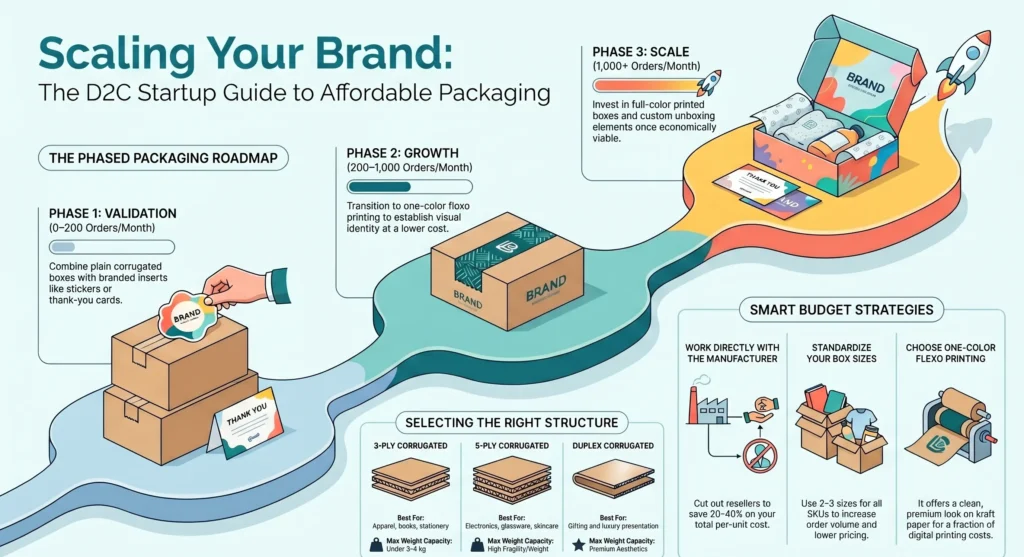
Corrugated boxes come in different ply configurations, and choosing the wrong one is one of the most common ways D2C startups waste money.
3-ply corrugated boxes are made with a single fluted layer sandwiched between two flat linerboards. They are lightweight, cost-effective, and perfectly suitable for most non-fragile products — clothing, books, dry food, accessories, and stationery. If your product does not need heavy protection and weighs under 3–4 kg, 3-ply is almost certainly the right choice.
5-ply corrugated boxes have two fluted layers with three liners. They are significantly stronger and recommended for electronics, glassware, ceramics, skincare with glass packaging, or anything that is both fragile and valuable. The added cost per unit is modest — but the reduction in damage claims and return rates makes it worth every rupee.
Duplex corrugated boxes are ideal when you want a premium look and feel alongside structural strength — popular for gifting, luxury skincare, or premium food brands where the outer box is part of the brand presentation.
Startup rule of thumb: Do not over-engineer your packaging. A clothing brand paying for 7-ply boxes is wasting money. A jewellery brand using a thin single-layer cardboard box is risking its reputation. Match the box to the actual product need.
The D2C Packaging Budget Breakdown: What You Are Actually Paying For
Let us demystify packaging costs, because this is where a lot of founders make assumptions that hurt them.
When you buy packaging, you are essentially paying for four things:
1. Material cost — the weight and grade of paper used (measured in GSM — grams per square metre). Higher GSM = heavier, stronger paper = higher cost.
2. Structure cost — the ply configuration (3-ply, 5-ply, 7-ply) and the flute type (B-flute, C-flute, E-flute, which affects cushioning and rigidity).
3. Size cost — larger boxes use more material. Custom sizes cost slightly more per unit than standard sizes because of the die-cutting and setup involved.
4. Print cost — this is where the biggest variable lies. A plain brown corrugated box costs far less than a full-colour printed box. One-colour flexo printing is substantially cheaper than four-colour digital or offset printing.
Understanding these four levers gives you real control over your packaging budget.
6 Smart Ways D2C Startups Can Get Custom Packaging Without Breaking the Budget
1. Start with Plain Boxes + Branded Inserts
This is the single most cost-effective strategy for startups shipping fewer than 500 orders per month.
A plain corrugated packing box from a quality manufacturer like Nirmal Packaging is clean, strong, and professional. On its own, it is not branded — but it is not embarrassing either. The key is what goes inside.
A custom-printed tissue paper wrap, a thank-you card, a sticker with your logo, or a small branded insert card transforms the unboxing experience entirely — at a fraction of the cost of fully printed outer boxes.
Here is why this works economically: a printed insert card with your brand logo and a message to the customer can be ordered for ₹2–5 per unit in quantities as low as 100–200 pieces. A custom-printed corrugated box requires setup costs (die-cutting, plate-making) that only become cost-effective at 500+ units, sometimes 1,000+.
So in your first phase — under 500 orders/month — invest in excellent plain boxes and a beautiful, branded inner experience. Your customers will notice and remember.
2. Order Smaller Quantities to Start, Scale Up as Volume Grows
The biggest mistake new brands make is trying to match the per-unit pricing of businesses that order 10,000 boxes at a time.
Yes, the per-unit cost at 500 pieces is higher than at 5,000 pieces. That is always true. But the cost of ordering 5,000 boxes before you have validated your product sizing, your courier setup, and your brand direction is far higher — because you will likely need to change something. And then you are stuck with thousands of boxes you cannot use.
At Nirmal Packaging, we work with brands at realistic starting quantities. Starting at 200–500 units lets you test, refine, and scale without committing cash you do not have.
As your monthly order volume grows from 100 to 500 to 1,000+ shipments per month, your packaging quantity per order naturally increases — and your per-unit cost falls. This is the natural, capital-efficient way to scale packaging costs alongside revenue.
3. Standardise Your Box Sizes Across Products
Many D2C startups sell multiple products in multiple sizes and make the mistake of ordering a different custom box for each SKU. This multiplies your setup costs, divides your order quantities, and makes warehouse management a nightmare.
The smarter approach is to standardise on two or three box sizes that can accommodate your full product range with appropriate void fill. A slightly larger box used with corrugated packing rolls as internal padding is often more cost-effective than buying ten different custom sizes.
For example, a skincare brand with six products — serums, moisturisers, face washes — can often standardise on two box sizes: a small box for single products and a medium box for bundles and gift sets. That doubles your per-size order quantity and brings the cost per unit down significantly.
4. Choose One-Colour Printing Over Full-Colour — Especially Early On
Here is something most packaging salespeople will not tell you: a one-colour printed corrugated box (your logo and brand name in a single ink colour on a kraft brown base) looks excellent and costs a fraction of four-colour printing.
Some of India’s most respected D2C brands — in the food, skincare, and home goods space — use single-colour printed kraft boxes precisely because the look is clean, natural, and premium. The brown kraft box with a black or dark green one-colour logo has become a design language in itself among sustainable and artisan brands.
One-colour flexographic printing on corrugated boxes is significantly cheaper than digital four-colour printing, requires less setup time, and is available at lower minimum order quantities with most manufacturers.
If your brand palette works with a kraft brown base, this is worth serious consideration.
5. Work Directly with a Manufacturer, Not a Reseller
This point matters more than almost any other in this guide.
There is an entire layer of packaging resellers and aggregators in India who buy boxes from manufacturers like Nirmal Packaging and sell them to small businesses at a significant markup. They are easy to find on IndiaMart and Justdial, they have slick websites, and they promise fast delivery. They are also adding 20–40% to your per-unit cost without adding any real value.
When you work directly with a manufacturer — a company that actually owns corrugated sheet machines, die-cutting equipment, and printing machinery — you cut out that markup entirely. You also get direct access to the people who actually make your boxes, which means faster resolution if there is ever a quality issue, and real flexibility on sizes and specifications.
Nirmal Packaging Industries manufactures corrugated boxes at our facility in Sector 10, Noida, using our own assembly line including multipurpose coater machines, die-cutting machines, and fully computerised box sample cutters. When you order from us, you are ordering from the source.
Contact us directly for a quote →
6. Use Corrugated Rolls for Inner Protection Instead of Buying Pre-Cut Void Fill
Corrugated rolls and corrugated packing rolls are one of the most underrated cost-saving tools available to D2C startups.
Rather than buying pre-cut bubble wrap sheets or foam sheets at a fixed size, corrugated rolls let you cut exactly the length you need for each product — no waste, no overspend. They offer excellent cushioning and shock absorption, are fully recyclable (which your customers will appreciate), and cost less than comparable bubble wrap on a per-metre basis.
For brands shipping fragile items — ceramics, glass bottles, electronic accessories — wrapping the product in corrugated roll before placing it in the box provides far better all-round protection than a loose sheet of bubble wrap placed on top.
The Real Cost of Cheap Packaging: Why Going Too Budget-Conscious Backfires
There is a floor below which you should not go on packaging quality, and it is worth being direct about this.
Very cheap packaging — thin walls, poor-quality paper, undersized boxes — leads to real and measurable business costs:
Damage and returns. A cracked product means a refund, a return shipment cost, a lost product, and a one-star review. The total cost of one damaged shipment often exceeds the saving you made on packaging across 20–30 orders.
Customer trust. A limp, dented box that arrives at someone’s door communicates that you do not care about quality. For a D2C brand where every customer is a potential repeat buyer and referral source, that impression is enormously costly.
Marketplace penalties. If you sell on Amazon or Flipkart alongside your D2C channel, consistently poor packaging leads to higher damage rates, which lowers your seller score and your visibility on the platform.
At Nirmal Packaging, every box we manufacture goes through quality checks including burst testing, ring crush testing, flat crush testing, and pin adhesion testing. We do not cut corners on material quality — and neither should you when choosing your packaging supplier.
What to Look for in a Packaging Supplier as a Startup
Not all packaging manufacturers are equal. Here is a practical checklist for evaluating any supplier before you commit:
Do they manufacture in-house, or do they resell? Ask directly. A manufacturer should be able to show you their production facility, their machinery, and their quality testing process.
What is their actual minimum order quantity? Some manufacturers quote large MOQs as a default. Ask whether they can accommodate smaller first orders for new brands.
Can they provide samples before bulk production? Any serious manufacturer will provide physical samples — either free or at a nominal cost. Never order a large batch of boxes without seeing and testing a sample first.
What is their turnaround time? For a startup, being able to reorder quickly when you run out of boxes is crucial. Ask about standard production lead times.
Do they test their packaging? Quality testing should not be optional. Ask about burst strength, GSM, and whether boxes are compression-tested for stacking.
What customisation options do they offer? Sizes, ply configurations, printing options — understand the full range before assuming limitations.
Nirmal Packaging Industries has been supplying corrugated boxes to businesses across Delhi NCR since 2011. We offer custom sizes, 3-ply and 5-ply configurations, duplex box options, and corrugated rolls — all manufactured and quality-tested at our Noida facility. See our full product range →
The Phased Approach to D2C Packaging: A Practical Roadmap
Rather than trying to have perfect branded packaging from day one, most successful D2C founders follow a phased approach that aligns packaging investment with revenue growth.
Phase 1 — Validation (0–200 orders/month)
Use plain corrugated boxes in the sizes that fit your products. Invest in branded inserts — a printed thank-you card, sticker, or tissue paper. Focus on getting the box size and strength right, not the branding. Keep costs low. Keep flexibility high.
At this stage, every rupee should go towards product and customer acquisition. Your packaging just needs to be clean, strong, and functional.
Phase 2 — Growth (200–1,000 orders/month)
Now you have validated your product, your sizes, and your customer profile. You have a shipping process in place. This is the right moment to introduce one-colour printed boxes at a sensible minimum order quantity. One-colour flexo printing on your corrugated boxes in batches of 300–500 gives your brand its first proper visual identity at the point of delivery without massive upfront investment.
Phase 3 — Scale (1,000+ orders/month)
At this volume, full-colour printed corrugated boxes become economically viable. You now have the order quantity to bring per-unit costs down to a level that makes premium packaging affordable. You can also explore custom inserts, ribbon pulls, and other unboxing elements that were not cost-effective earlier.
This roadmap lets you invest in packaging in proportion to your revenue — which is exactly how sustainable D2C brands are built.
| Packaging Type | Ply Configuration | Recommended Product Use Case | Key Features | Protection Level (Inferred) | Pros and Cons |
|---|---|---|---|---|---|
| 5-Ply Corrugated Box | Two fluted layers with three liners | Fragile or valuable items: electronics, glassware, ceramics, skincare with glass packaging, and home décor | High structural strength, shock absorption, and moisture resistance options | High (designed for fragile and heavy goods) | Pros: Reduces damage claims and returns significantly. Cons: Slightly higher cost than 3-ply. |
| Duplex Corrugated Box | Corrugated fluting with a duplex board outer liner | Gifting, luxury skincare, premium food brands, and premium SKUs | Premium look and feel with a high-quality outer finish for branding | High (combines strength with aesthetics) | Pros: Excellent branding impact and unboxing experience. Cons: Higher cost per unit. |
| 3-Ply Corrugated Box | Single fluted layer between two flat linerboards | Non-fragile items: clothing, fashion, books, dry food, accessories, and stationery | Lightweight, cost-effective, and standard for most eCommerce | Moderate (suitable for items under 3–4 kg) | Pros: Very affordable and low shipping weight. Cons: Low protection for heavy or fragile goods. |
| Plain Corrugated Box with Branded Inserts | Typically 3-ply or 5-ply (standard) | Early-stage D2C startups (0–500 orders/month) | Uses plain outer boxes with custom stickers, tissue paper, or thank-you cards | Varies (based on chosen box ply) | Pros: Extremely cost-effective for low volumes with a professional look. Cons: Lacks external brand visibility during transit. |
| Corrugated Packing Rolls | Flexible fluted paper (roll form) | Inner protection for ceramics, glass bottles, and electronic accessories | Customizable length, shock absorption, and fully recyclable | Supplementary (excellent for internal cushioning) | Pros: More eco-friendly and cost-effective than bubble wrap. Cons: Requires manual cutting and wrapping. |
The Startup Guide to Affordable Custom D2C Packaging
Industry-Specific Packaging Tips for Common D2C Categories
Skincare & Beauty Brands
Glass bottles and jars are heavy and fragile. Use 5-ply corrugated boxes as your outer box. Wrap individual bottles in corrugated packing rolls for individual protection. For bundles and gift sets, consider duplex corrugated boxes which offer both strength and a cleaner outer appearance. Moisture resistance matters — specify this when ordering if your products ship during monsoon months.
Fashion & Apparel Brands
Clothing is lightweight and non-fragile, making it ideal for 3-ply corrugated boxes. The bigger consideration here is the unboxing experience — this category has the highest consumer expectation for branded, premium packaging. Invest in custom tissue paper, ribbons, and branded stickers. The box itself can be plain kraft; the interior experience is where your brand lives.
Food & Dry Snacks
Check food safety requirements first — corrugated boxes for direct food contact need to be food-grade certified. For outer packaging of sealed food products, standard 3-ply corrugated boxes work well for most dry goods. For products with moisture sensitivity, discuss moisture-resistant liner options with your supplier.
Home Décor & Gifts
This category often involves irregularly shaped, fragile items — candles, ceramic décor, glassware. Invest in appropriate 5-ply corrugated boxes and generous corrugated roll padding. Dimensional weight charges from courier companies are also a factor — do not over-box unnecessarily large items. If the gift occasion is important to your brand, duplex boxes with a clean outer finish are worth considering for premium SKUs.
FAQs: Custom Packaging for D2C Startups
What is the minimum order quantity for corrugated boxes at Nirmal Packaging? We work with businesses at realistic quantities for their stage of growth. Contact us to discuss your specific requirement and we will advise on what is feasible. Get in touch here →
Can I get custom-sized boxes, or only standard sizes? We manufacture corrugated boxes in custom sizes using fully computerised box sample cutters and die-cutting machines. Custom sizing is available and often the right choice for unusual product dimensions.
How long does it take to produce a batch of corrugated boxes? Standard production lead time depends on the order size and specifications. Contact us with your details and we will give you an accurate timeline.
Is plain corrugated packaging actually acceptable to customers, or will it hurt my brand? A clean, correctly-sized, undamaged plain corrugated box is far better received by customers than a flimsy printed box that arrives crushed. Quality first, branding second — especially in early stages.
Do you supply to locations outside Noida and Delhi NCR? Yes. While we are based in Noida and primarily serve Delhi NCR, we supply to businesses across India. Contact us to discuss delivery to your location.
What is the difference between corrugated rolls and bubble wrap for inner protection? Corrugated packing rolls are recyclable, cost-effective, and provide excellent cushioning for most product types. Bubble wrap has slightly higher cushioning for very fragile items but is not recyclable. For most D2C products, corrugated rolls are the better all-round choice.
Conclusion: Build Your Brand the Smart Way, From the Box Up
Good packaging for a D2C startup is not about spending the most money. It is about spending the right money, at the right time, on the right things.
Start with the basics: the right ply for your product, the right size for your dimensions, and a clean functional box from a manufacturer — not a reseller — who quality-tests every batch.
Add simple, affordable branded touches — a printed card, a sticker, a tissue wrap — to create an unboxing experience that feels personal and professional.
Scale into fully printed, fully custom packaging as your monthly volume makes it economically sensible.
And throughout all of it, work with a packaging partner who understands your scale and can grow with you.
At Nirmal Packaging Industries, we have been doing exactly that for businesses across Delhi NCR since 2011. We manufacture corrugated boxes, corrugated packing boxes, duplex corrugated boxes, warehouse parcel boxes, corrugated rolls, and corrugated packing rolls — everything a growing D2C brand needs, under one roof, in Noida.
Ready to talk packaging?
📞 Call us: +91 9711414139 📦 See our products: nirmalpackaging.in/product 📬 Contact us: nirmalpackaging.in/contact-us 📖 Read more on our blog: nirmalpackaging.in/blogs
Nirmal Packaging Industries | C-192, Sec-10, Noida, Gautam Buddha Nagar – 201301 | Est. 2011 | info@nirmalpackaging.com
Related Reads:
- Corrugated Boxes for Ecommerce in India — The Practical Guide Every Amazon and Flipkart Seller Needs
- 3 Ply vs 5 Ply Corrugated Box — Which One Is Right for Your Business?
- Eco-Friendly Packaging in India — Options, Cost & Why Businesses Are Switching
- Cardboard vs Corrugated Boxes — Which One Should You Actually Be Using?