Cardboard vs Corrugated Boxes: Which One Should You Actually Be Using?
Cardboard vs Corrugated Boxes: Which One Should You Actually Be Using?
By Nirmal Packaging
Most people use the words “cardboard box” and “corrugated box” interchangeably. Walk into any warehouse, talk to any shipper, and you’ll hear both terms thrown around like they mean the same thing. But they don’t — and that confusion is quietly costing businesses money, products, and customers every single day.
If you’ve ever had a shipment arrive crushed, a box collapse mid-warehouse, or wondered why your competitor’s packaging looks sturdier than yours — this article was written for you.
The Big Confusion Nobody Talks About
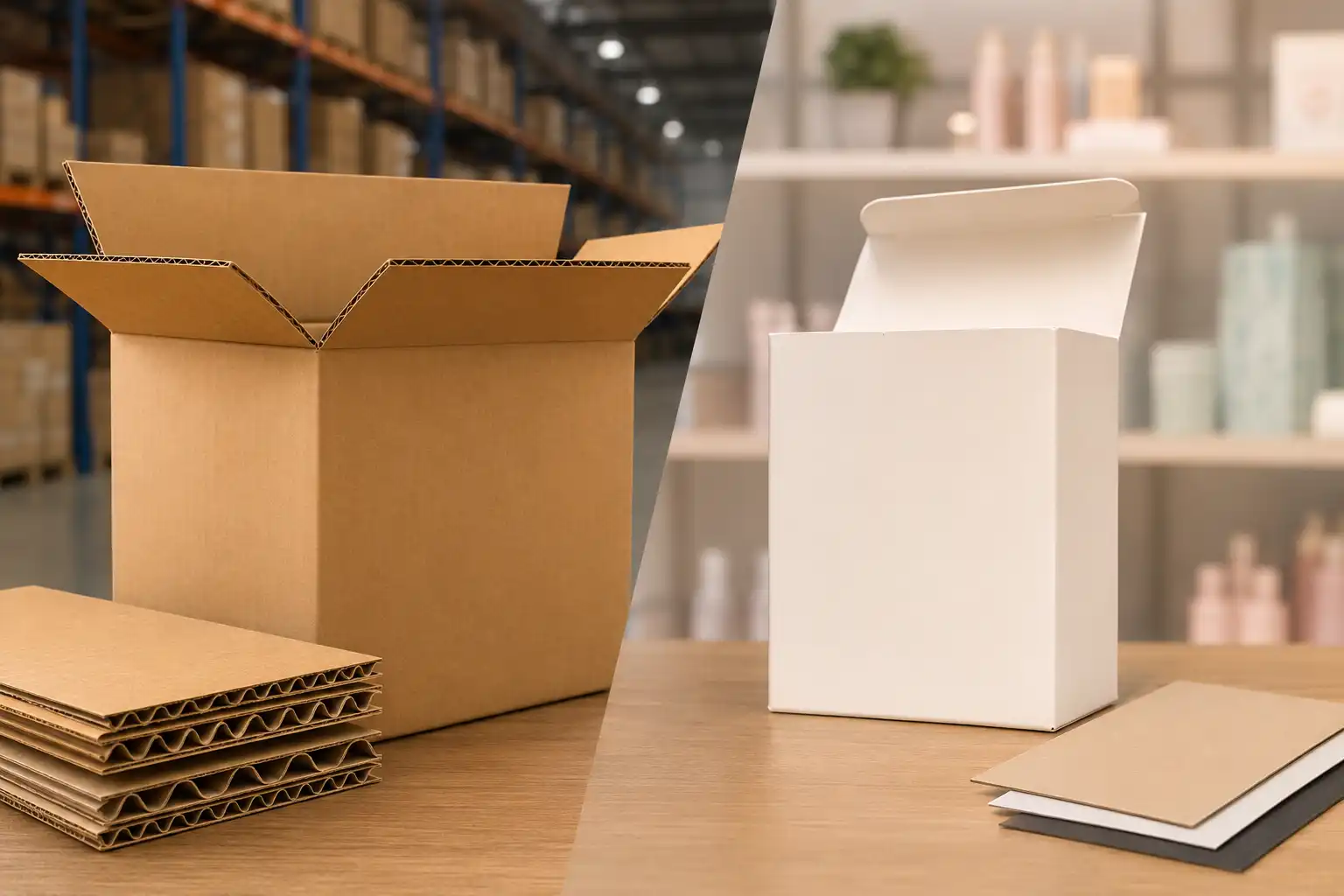
Here’s the truth: when most people say “cardboard box,” what they actually mean is a corrugated box. Real cardboard — the flat, single-layer stuff — is what your cereal box or greeting card is made from. It’s thin, lightweight, and meant for display-ready retail packaging. It’s not meant for shipping, stacking, or storing anything heavier than a birthday cake.
Corrugated boxes, on the other hand, are a completely different product. They have three layers — a wavy (or fluted) inner layer sandwiched between two flat liner sheets — and that structure is what gives them their legendary strength, cushioning ability, and durability.
Understanding the difference between these two materials isn’t just academic knowledge. For any business that ships products, stores goods, or manages a supply chain, choosing the wrong box type means dealing with damaged shipments, customer complaints, return headaches, and wasted packaging budgets.
Let’s break this down completely.
What Is Cardboard, Really?
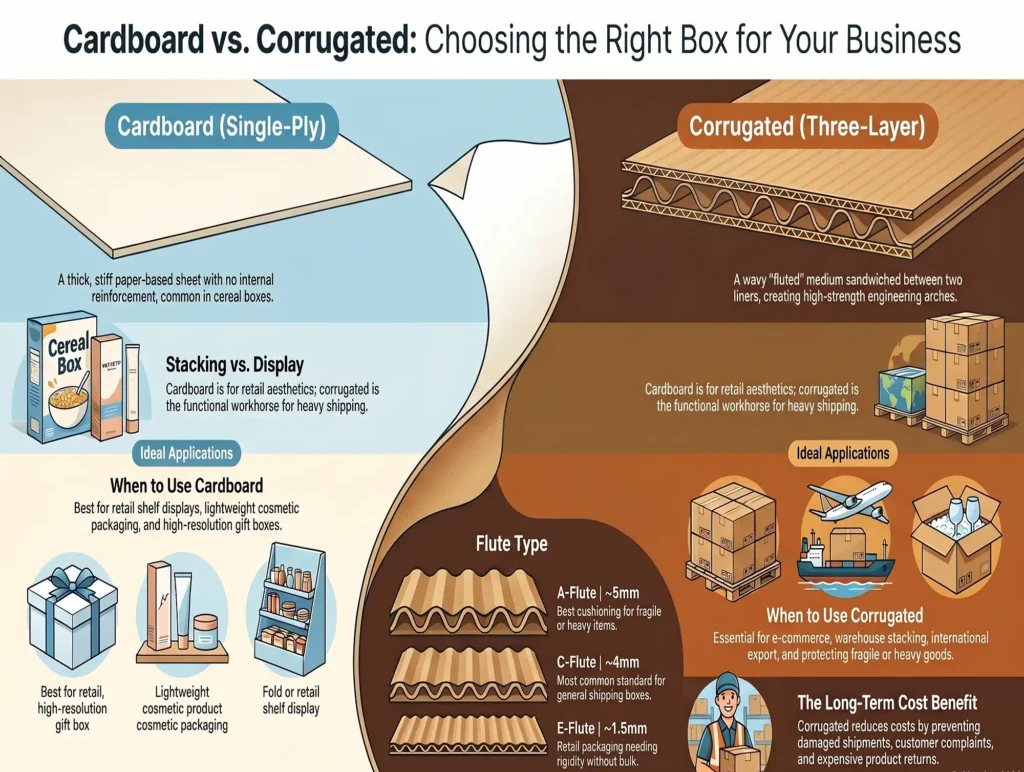
Cardboard is a generic term for thick, stiff paper-based material. It’s a single-ply sheet — meaning it has no internal structure, no fluting, no layers working together for strength. Think of a shoe box. A cereal box. A cosmetic packaging box on a retail shelf. That’s cardboard.
Cardboard is typically used for:
- Retail display packaging
- Greeting cards and book covers
- Small product boxes that sit on shelves
- Lightweight packaging where protection isn’t a top concern
- Point-of-sale displays and promotional packaging
Cardboard has great surface properties for printing — colors pop, logos look sharp, and it can be given a glossy or matte finish easily. That’s why it’s the material of choice for anything that needs to look attractive on a store shelf.
But try to ship a box of auto parts in cardboard and see what happens. It’ll crumple under pressure. Stack three cardboard boxes on top of each other in a warehouse and the bottom one will cave. It’s simply not built for that kind of stress.
What Is a Corrugated Box?
A corrugated box — also called a corrugated carton or corrugated fiberboard box — is made from corrugated board. This board has a distinctive structure that sets it apart from every other packaging material:
The three-layer construction:
- Top liner — the flat outer layer (often printed on)
- Fluted medium — the wavy, arched inner layer that provides cushioning and structural rigidity
- Bottom liner — the flat inner layer
That fluted medium is the key. It creates a series of parallel arches, and arches are one of the strongest structural shapes in engineering. This is why corrugated boxes can bear tremendous compressive weight, absorb impact shocks, and resist moisture far better than plain cardboard ever could.
At Nirmal Packaging, we’ve been manufacturing corrugated boxes in Noida since 2011, and the most common thing we hear from first-time clients is: “I had no idea how different these were from regular cardboard boxes.”
Cardboard vs Corrugated Boxes: A Detailed Comparison
Let’s put the two head-to-head across the factors that actually matter for your business:
1. Structural Strength
Cardboard: Single ply, no internal reinforcement. Handles light loads in static conditions (shelves, display stands). Fails quickly under stacking pressure or physical stress during transit.
Corrugated: Multi-layered with a fluted core. The arch structure distributes compressive load across the entire board, allowing corrugated boxes to withstand hundreds of kilograms of stacking force depending on the flute type and board grade.
If you’re running a warehouse or shipping products cross-country — or even across the city — corrugated boxes aren’t optional. They’re the only sensible choice.
2. Protection During Shipping and Transit
This one isn’t even close.
Corrugated boxes are designed to absorb impact. When a box gets dropped, bumped, or stacked awkwardly in a delivery truck, the fluted layer acts like a built-in cushion — compressing slightly to absorb the shock before it reaches your product.
Cardboard has no such mechanism. It transfers impact energy directly to whatever’s inside.
Our corrugated packing boxes are specifically engineered for exactly this kind of transit protection. Whether your goods are moving by road across Delhi NCR or by courier to a buyer three states away, the box needs to handle real-world handling conditions — not laboratory-perfect ones.
3. Weight Capacity and Load Bearing
Corrugated boxes come in multiple flute types — A-flute, B-flute, C-flute, E-flute, and F-flute — each offering different thickness and load-bearing capacities. You can also get double-wall and triple-wall corrugated for extremely heavy or fragile items.
Cardboard has no such grading system because its load-bearing capacity is simply not the point. You don’t buy cardboard for strength.
For anyone shipping heavy goods — machine parts, industrial equipment, bulk grocery items, appliances — you’ll want to look at duplex corrugated boxes or heavy-duty variants that can handle serious weight without deforming.
4. Moisture Resistance
Cardboard absorbs moisture quickly. Humidity weakens its already-limited structure, making it limp and useless.
Corrugated fiberboard is more moisture-resistant by design, especially when treated liners or coatings are used. It won’t survive total water immersion, but in a typical warehouse or transit environment where humidity fluctuates, a good corrugated box will hold its shape far longer than cardboard.
This matters enormously in India, especially during monsoon season, when packaging failure rates spike significantly if businesses are using the wrong materials.
5. Customization and Printing
Here’s where cardboard holds its own. Because it’s smooth and uniform, cardboard takes high-resolution printing beautifully. Retail cosmetic packaging, luxury product boxes, and premium gift packaging often use cardboard for exactly this reason — it looks polished and premium.
Corrugated boxes can absolutely be printed on (and we do this for many clients), but the texture of the liner slightly affects print clarity compared to flat cardboard. For high-end retail presentation, you might want a cardboard outer sleeve over a corrugated inner box — getting the best of both worlds.
For B2B shipping, warehousing, and e-commerce fulfillment where the box is a delivery vehicle rather than a display medium, corrugated wins.
6. Cost
Cardboard is generally cheaper per unit for small quantities. But when you factor in the damage rates, return costs, and customer complaints that come with using the wrong packaging, the math flips quickly.
Corrugated boxes offer better value over the full shipping lifecycle. One damaged shipment can cost more than hundreds of corrugated boxes.
We supply corrugated boxes in bulk to businesses across Noida, Delhi, and NCR at competitive rates. If you’re ordering in volume, pricing per box drops significantly — reach out to us to discuss bulk pricing.
7. Eco-Friendliness and Sustainability
Both materials are recyclable. But corrugated boxes have a clear edge in sustainability metrics:
- They use recycled fiber in both liner and fluting
- They’re 100% recyclable post-use
- They’re biodegradable
- They can be reused multiple times before recycling
Businesses with ESG commitments or sustainability reporting requirements are increasingly specifying corrugated as their primary packaging material.
Flute Types in Corrugated Boxes: Why It Matters
Since we’re talking corrugated, let’s quickly explain the flute types — because choosing the right flute for your application makes a huge difference.
A-Flute: The thickest flute. Best cushioning and compression resistance. Great for fragile, heavy items. About 5mm thick.
B-Flute: Flatter, more puncture resistant. Good for canned goods and retail-ready packaging. About 3mm thick.
C-Flute: The most commonly used flute. Balanced strength and cushioning. Most general shipping boxes are C-flute. About 4mm thick.
E-Flute: Very thin. Used for retail point-of-sale packaging and smaller product boxes where you want rigidity without bulk. About 1.5mm thick.
F-Flute: Even finer than E. Mostly used for cosmetics, food packaging, and micro-retail applications.
For most B2B shipping and warehouse applications, C-flute single-wall or B-flute double-wall will cover the majority of use cases. Our team can help you identify the right specification for your specific product.
Single Wall vs Double Wall vs Triple Wall Corrugated
Beyond flute type, corrugated boards also vary by wall construction:
Single Wall (Standard): One fluted medium between two liners. Handles most standard shipping requirements. Ideal for e-commerce, retail distribution, and light-to-medium industrial use.
Double Wall: Two fluted mediums with three liners. Significantly heavier load capacity. Used for heavy products, long-distance shipping, and warehouse stacking where boxes sit under substantial weight.
Triple Wall: The heavy-duty option. Three fluted mediums with four liners. Can replace wooden crates in some applications. Used for industrial machinery, export shipments, and extremely heavy products.
Our warehouse parcel boxes are built to handle the demands of high-volume warehouse operations and last-mile delivery conditions.
Who Should Use Cardboard vs Corrugated?
Here’s a simple way to think about it:
You might genuinely need cardboard if:
- You’re a retail brand selling consumer goods on store shelves
- Your packaging is purely for product display and presentation
- You’re selling lightweight items where transit protection isn’t a concern
- You’re creating gift boxes, cosmetic packaging, or luxury retail boxes
- You want vivid, high-resolution printing as the primary requirement
You definitely need corrugated boxes if:
- You’re shipping products via courier, road freight, or logistics partners
- You’re storing goods in a warehouse where boxes get stacked
- Your products are heavy, fragile, or valuable
- You’re running an e-commerce operation where packages travel through sorting facilities
- You’re exporting products internationally
- You need packaging that protects against environmental factors like humidity
For virtually every business that moves physical products, corrugated boxes are the workhorse of the supply chain. Cardboard is the fashion choice; corrugated is the functional one.
The E-Commerce Angle: Why Corrugated Is Non-Negotiable for Online Sellers
India’s e-commerce market has exploded over the past five years, and with it, the demand for reliable shipping packaging. When your customer orders something online and it arrives crushed or damaged, they don’t blame the courier — they blame you, the seller.
Corrugated boxes are built for exactly the e-commerce journey:
- Multiple handling touchpoints — a package gets handled 6–8 times from warehouse to doorstep. Each touchpoint is a potential damage point.
- Automated sorting systems — courier hubs run packages through mechanical conveyor systems that apply real physical pressure. Cardboard doesn’t survive this.
- Stacking in transit vehicles — packages get stacked, compressed, and shifted during transport. You need structural integrity throughout.
- Last-mile variability — the final delivery leg is the least controlled. Packages get dropped, set down roughly, and sometimes left in unfavorable weather conditions.
If you’re selling on Flipkart, Amazon, Meesho, or your own D2C website, your packaging choice is directly linked to your seller rating and customer satisfaction scores.
We work with several e-commerce businesses across Noida and Delhi NCR. Our corrugated boxes are sized and graded for e-commerce shipping requirements — not just warehouse storage.
Common Myths About Corrugated Packaging — Debunked
Myth 1: “Corrugated boxes are too expensive for small businesses.”
Not true. Bulk pricing makes corrugated boxes very affordable. And the cost of one damaged shipment almost always exceeds the savings of using cheaper cardboard alternatives. We work with businesses of all sizes, including small sellers who need modest quantities.
Myth 2: “All boxes look the same to the customer anyway.”
Customers absolutely notice packaging quality. Multiple studies have shown that unboxing experience affects brand perception, repeat purchase intent, and social media sharing. A box that arrives intact, clean, and structurally sound signals that your brand cares about quality.
Myth 3: “You can just use extra bubble wrap to compensate for a weak box.”
You can cushion your product all you want, but if the box walls fail under compressive load or the structure collapses under stacking weight, the internal cushioning doesn’t help. The box structure itself is your first line of defense.
Myth 4: “Corrugated boxes aren’t eco-friendly because they use more material.”
Corrugated boxes contain significant amounts of recycled fiber and are themselves highly recyclable. They often have a lower overall environmental impact than multi-layer plastic packaging or excessive bubble wrap use.
How to Choose the Right Corrugated Box for Your Business
When you’re evaluating corrugated box specifications, here are the key parameters to consider:
1. Box Style Regular Slotted Container (RSC) is the most common — four flaps on top and bottom. Other styles include Full Overlap Slotted (FOL), Half Slotted Container (HSC), and die-cut custom styles.
2. Flute Type As discussed above — match the flute to your product weight and fragility requirements.
3. Board Grade (ECT vs Mullen) Edge Crush Test (ECT) measures stacking strength — relevant for warehouses and stacking-heavy environments. Mullen Burst Test measures puncture resistance — relevant for rough handling and sharp-edged products.
4. Custom Sizing Standard sizes are cheaper, but custom sizing reduces void fill requirements and provides better product protection. For high-volume shippers, custom-sized boxes often reduce overall packaging costs.
5. Printing and Branding Requirements If you want your logo or branding on the box, single-color flexographic printing on the liner is cost-effective. Full-color printing is also available for premium branding requirements.
Our team at Nirmal Packaging works with you to identify the right spec for your specific application. We don’t just sell boxes — we help you find the right packaging solution.
Why Businesses Across Delhi NCR Trust Nirmal Packaging
Since 2011, we’ve been manufacturing corrugated packaging solutions from our facility in Sector 10, Noida. Here’s what sets us apart:
In-house quality testing — every batch goes through moisture testing, ring crush testing, burst testing, flat crush testing, and box compression testing. You get boxes that actually perform.
Modern manufacturing technology — our facility runs sheet laminators, multipurpose coaters, multiple die-cutting machines, a fully computerized box sample cutter, and a complete corrugated box manufacturing assembly line.
Custom solutions — we manufacture to your specifications, not the other way around. Any size, any flute, any wall thickness.
Bulk supply capability — whether you need 500 boxes or 50,000, we have the production capacity and inventory management to keep your supply chain running without interruption.
Experienced team — over a decade of experience across hundreds of clients in manufacturing, e-commerce, FMCG, pharmaceuticals, automotive, and more.
You can explore our full product range — from standard corrugated boxes to corrugated packing rolls — on our products page.

Real Talk: What We See in the Market
Over the years, we’ve spoken with hundreds of businesses that came to us after a packaging failure — a logistics partner that crushed their goods, a monsoon-season delivery that arrived soaked and collapsed, a warehouse that lost inventory to structural box failure.
In nearly every case, the root cause was either using the wrong box type altogether (cardboard instead of corrugated) or using an underspecified corrugated box (single wall when double wall was needed, wrong flute for the product weight).
Packaging is one of those operational decisions that seems minor until it goes wrong. Then it becomes very expensive, very fast.
If you’re not sure what specifications your products need, or if you’ve been experiencing higher-than-expected damage rates, it’s worth having a conversation with a packaging expert before your next order.
We’re happy to review your current packaging and suggest improvements — no obligation.
Frequently Asked Questions: Cardboard vs Corrugated Boxes
Q: Is corrugated the same as cardboard? No. While people often use the terms interchangeably, they refer to different products. Cardboard is a single-ply flat sheet used in retail packaging and displays. Corrugated board has a multi-layer structure with a fluted inner medium that provides cushioning and structural strength.
Q: Which is stronger — cardboard or corrugated? Corrugated is significantly stronger than cardboard. The arch-shaped fluting in corrugated board distributes compressive load and absorbs impact in ways that flat cardboard simply cannot.
Q: Can corrugated boxes be recycled? Yes. Corrugated boxes are among the most widely recycled packaging materials in the world. They’re accepted by virtually all municipal recycling programs and commercial recycling facilities.
Q: What is the difference between single-wall and double-wall corrugated? Single-wall corrugated has one fluted medium between two liners — sufficient for most standard shipping. Double-wall has two fluted mediums and three liners, offering greater stacking strength and puncture resistance for heavier or more valuable goods.
Q: Are corrugated boxes good for e-commerce shipping? Absolutely. Corrugated boxes are the industry standard for e-commerce packaging because they handle multiple handling touchpoints, automated sorting systems, and the stacking forces encountered during last-mile delivery.
Q: How do I know what size corrugated box I need? The ideal box size is one where your product fits with 1–2 inches of space on each side for cushioning material, and the box can be closed flat without straining the flaps. Contact our team at Nirmal Packaging for guidance on sizing.
Q: Where can I buy corrugated boxes in Noida or Delhi NCR? Nirmal Packaging manufactures and supplies corrugated boxes from our facility in Sector 10, Noida. We serve businesses across Delhi NCR and ship to other regions as well. Call us at +91 9711414139 or visit our contact page.
A Quick Summary: Cardboard vs Corrugated
| Feature | Cardboard | Corrugated |
| Structure | Single-ply flat sheet | Multi-layer with fluted medium |
| Strength | Low | High to Very High |
| Cushioning | None | Built-in (fluted layer) |
| Moisture Resistance | Poor | Moderate to Good |
| Printing Quality | Excellent | Good |
| Shipping Suitability | Poor | Excellent |
| Stacking Ability | Minimal | Strong |
| Eco-Friendliness | Recyclable | Highly Recyclable |
| Best For | Retail display, gift boxes | Shipping, storage, e-commerce |
| Cost Efficiency (long-term) | Lower | Higher (fewer damage losses) |
The Bottom Line
If your box is leaving your hands and traveling somewhere — to a customer, to a warehouse, to a retail distributor — it needs to be corrugated. Full stop.
Cardboard has its place in retail environments where packaging is meant to look beautiful on a shelf, not survive a 300-km truck journey. For everything else, corrugated is the material that does the actual work.
The good news is that corrugated packaging has never been more accessible, more customizable, or more affordable — especially when you work with a dedicated manufacturer who understands your business requirements.
At Nirmal Packaging, we’ve spent over a decade helping businesses in Noida, Delhi, and across India get their packaging right. We manufacture corrugated boxes across specifications, sizes, and volumes — and we’re happy to help you figure out exactly what you need.
Browse our complete product range, read more on our packaging blog, or simply give us a call at +91 9711414139. We’ll take it from there.
Related reading from our blog:
- What’s the Strongest Type of Corrugated Box for Moving?
- What Are Duplex Corrugated Boxes? Benefits, Uses & Buying Guide
- Complete Guide to Corrugated Packaging: Types, Benefits, Uses & Buying Guide (2026)
- What’s the Strongest Type of Box for Heavy Items?
Nirmal Packaging Industries C-192, Sector 10, Noida, Gautam Buddha Nagar – 201301 📞 +91 9711414139 | 📧 info@nirmalpackaging.com Visit our website | WhatsApp us