What’s the Strongest Type of Box for Heavy Items? Here’s What Actually Works
What’s the Strongest Type of Box for Heavy Items? Here’s What Actually Works
By Nirmal Packaging | Packaging That Protects What Matters
Let me tell you something that happens more often than people admit.
A business packs up a heavy shipment — maybe some machine parts, a bulk order of industrial goods, or a large piece of equipment — into what looks like a perfectly decent box. The tape goes on. The courier picks it up. And somewhere between the warehouse and the customer, the bottom gives out. The item is damaged. The customer is furious. And now you’re dealing with a return, a replacement, and a dent in your reputation.
That scenario? Completely avoidable. Most of the time, it comes down to one simple thing: the wrong box was used.
Picking a box for heavy items isn’t just about finding something big enough to fit the product. It’s about understanding load capacity, material strength, flute type, and a dozen other things that most people never think about — until something goes wrong.
So let’s fix that. Here’s everything you need to know about the strongest boxes for heavy items, written plainly without the jargon overload.
First, Why Do So Many Boxes Fail?
Before we talk about what works, it helps to understand why regular boxes fall apart under heavy loads.
Standard single-wall corrugated cardboard — the kind that most everyday shipping boxes are made from — is designed for lighter goods. It handles maybe 15–20 kg on a good day, in good conditions. Push it beyond that, or expose it to a bit of moisture, or stack something heavy on top of it, and it starts to compress, buckle, and eventually collapse.
The problem is that many businesses, especially smaller ones, grab whatever boxes are available rather than sourcing ones rated for their actual product weight. It feels like a small saving upfront. But one damaged shipment can cost far more than what you’d have spent on proper heavy-duty packaging in the first place.
The other common mistake? Not accounting for the journey. A box sitting still in a controlled environment is very different from a box being loaded, unloaded, stacked, shifted, and transported over bumpy roads for 500 kilometres. Heavy items move around. They press against the walls. The base takes the full brunt of every bump.
Good packaging for heavy items needs to handle all of that — not just the weight when it’s sitting still.
So, What Are the Strongest Box Options?
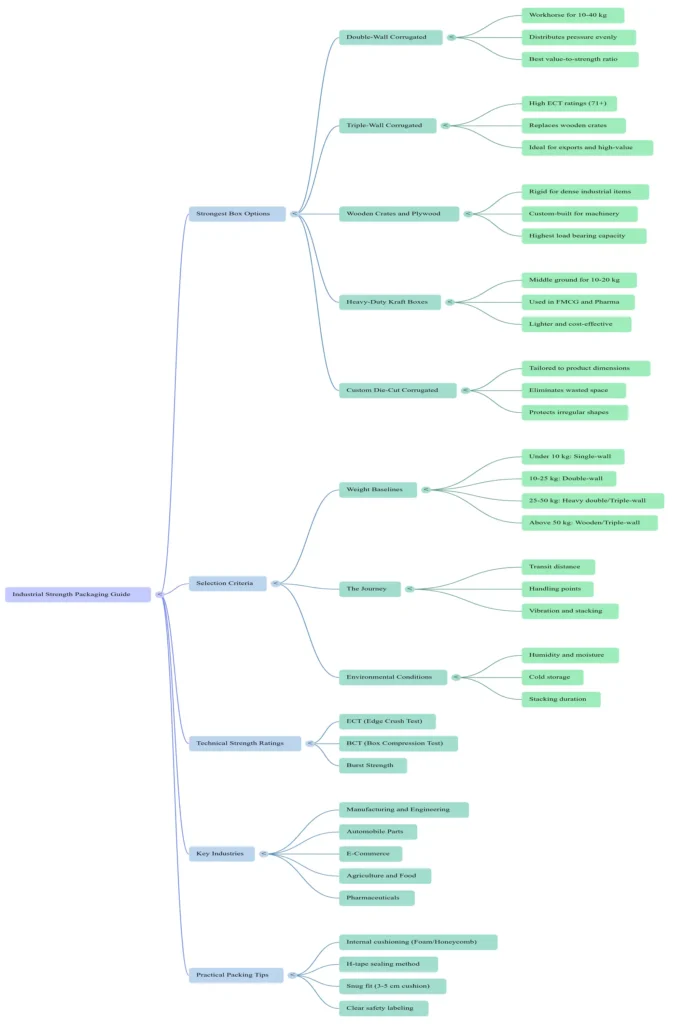
Double-Wall Corrugated Boxes — The Workhorse
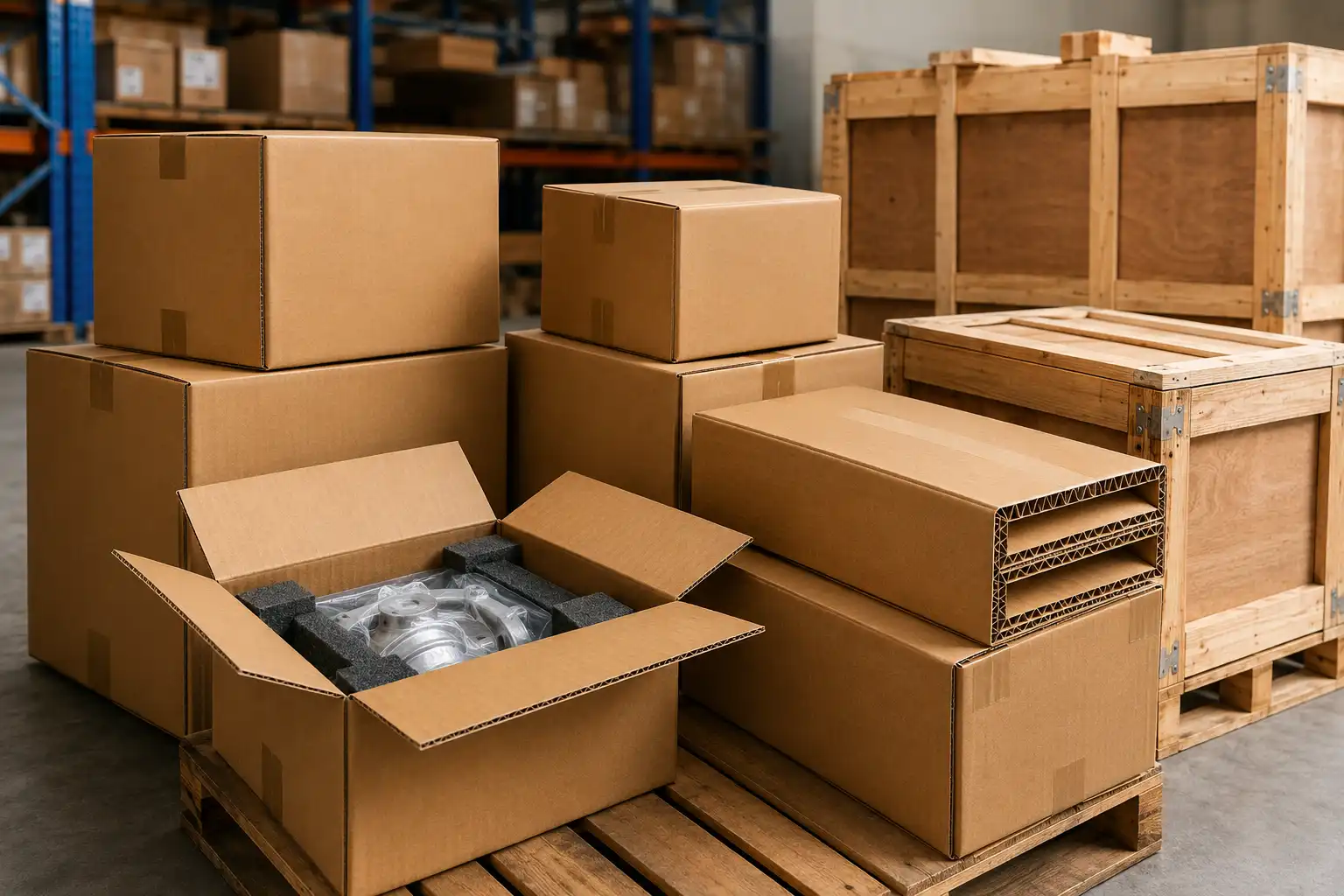
If I had to recommend one type of box that covers the widest range of heavy-item needs, it would be the double-wall corrugated box. These are built with two layers of the inner wavy fluting — and three flat liner sheets holding it all together. That structure makes them dramatically stronger than standard boxes.
They’re used everywhere — auto parts, electronics, bulk grocery, industrial tools, retail goods. If you’re shipping something between 10 and 40 kg, double-wall corrugated is almost always the right starting point.
What makes them so reliable isn’t just the thickness — it’s how they distribute pressure. The double-flute structure spreads the load more evenly across the box walls, which means they hold their shape better under both static and dynamic stress.
At Nirmal Packaging, double-wall corrugated boxes are consistently among the most requested products — because businesses across industries have figured out that this is where the value-to-strength ratio is best.
Triple-Wall Corrugated — When You Can’t Risk It
Triple-wall corrugated is essentially double-wall’s bigger, tougher sibling. Three flute layers. Four liner sheets. Substantially higher edge crush test (ECT) ratings — often 71 ECT or above.
These boxes are used when the stakes are high. Aerospace components. Large industrial spare parts. Exports that will be on a ship for weeks. Items worth lakhs that simply cannot arrive damaged.
They’re heavier and more expensive than double-wall, which is why most businesses don’t need them for everyday shipping. But for specific use cases — particularly long-distance or international freight — they’re genuinely worth every rupee.
One thing people don’t always realise: triple-wall boxes can often replace wooden crates for certain applications. They’re lighter, easier to handle, and still provide enormous compressive strength. That matters when you’re calculating freight weight.
Wooden Crates and Plywood Boxes — The Heavy Hitters
For really heavy, dense, or irregularly shaped industrial items, corrugated sometimes isn’t the answer. That’s where wooden crates and plywood boxes come in.
These are custom-built, rigid structures that can bear loads that would flatten any cardboard option. Machine tools, heavy engineering equipment, large auto components, chemical plant parts — industries that deal with these items know wooden packaging is often the only practical solution.
The advantages are real: wooden crates don’t deform under weight, they can be nailed or strapped securely, and they can be built to exact internal dimensions so the item doesn’t shift at all during transit.
The trade-off is cost and weight. Wood is heavier, which affects freight charges, and custom crates take more time and skill to produce. But when you’re shipping something worth crores, that’s a conversation you don’t even need to have — you just use the right packaging.
Heavy-Duty Kraft Boxes — Lighter Heavy Items
Not everything “heavy” is industrial-grade. Sometimes you’re packing items in the 10–20 kg range — boxed appliances, bulk food products, large retail items — where double-wall corrugated might be overkill but standard boxes definitely aren’t enough.
Heavy-duty kraft paper boxes, made from high-GSM kraft with reinforced construction, fill that middle ground nicely. They’re lighter to handle, cheaper to produce, and still offer solid protection for goods that don’t need industrial-level packaging.
FMCG companies, pharma distributors, and retail warehouses use these regularly. They also stack well and are easy to store flat, which matters when you have limited warehouse space.
Custom Die-Cut Corrugated Boxes — When the Item is Awkward
Here’s a situation that comes up all the time: the product doesn’t fit neatly into any standard box size. Maybe it has a protruding handle. Maybe it’s fragile in one specific spot. Maybe it needs to be oriented a particular way during transport.
Standard off-the-shelf boxes can’t solve this. Custom die-cut corrugated boxes can.
When a box is designed specifically around your product — its exact dimensions, its weight distribution, its fragile points — it performs dramatically better. There’s no wasted internal space where the item can shift. The corners and edges are reinforced exactly where they need to be. The weight is distributed properly across the base and walls.
This is especially relevant for manufacturers, exporters, and growing e-commerce businesses that are shipping the same product repeatedly. Investing in a custom box design upfront saves money over time through fewer damages and returns. Nirmal Packaging offers custom corrugated packaging built around your specific product requirements — not generic sizes you have to make work.
| Packaging Type | Material Structure | Weight Capacity | Primary Use Cases | Key Advantages | Load Distribution Method | Durability Rating (Inferred) |
|---|---|---|---|---|---|---|
| Triple-Wall Corrugated Boxes | Three flute layers and four liner sheets | 25 kg to over 50 kg | Aerospace components, large industrial spare parts, export freight, high-value goods | High compressive strength (71+ ECT), can replace wooden crates, lighter than wood for freight | High edge crush resistance (ECT) through triple-layer fluting | Very High |
| Wooden Crates and Plywood Boxes | Custom-built rigid wooden or plywood structures | 50 kg and above | Machine tools, heavy engineering equipment, chemical plant parts, irregular industrial items | Does not deform under weight, can be nailed or strapped, maximum rigidity | Rigid frame support and custom internal dimensioning | Maximum |
| Double-Wall Corrugated Boxes | Two layers of inner wavy fluting and three flat liner sheets | 10 kg to 40 kg | Auto parts, electronics, bulk grocery, industrial tools, retail goods | Value-to-strength ratio, holds shape under static and dynamic stress, reliable load distribution | Spreads load evenly across box walls through double-flute structure | High |
| Custom Die-Cut Corrugated Boxes | Product-specific corrugated design with reinforced corners/edges | Varies based on design | Irregularly shaped products, fragile items, e-commerce repeated shipping | No wasted internal space, specific protection for fragile points, reduces damages | Tailored distribution across base and walls based on product dimensions | High (Optimized) |
| Heavy-Duty Kraft Boxes | High-GSM kraft with reinforced construction | 10 kg to 20 kg | Boxed appliances, bulk food, FMCG, pharma distributors, retail warehouses | Lighter and more cost-effective than double-wall, easy to store flat, stacks well | Reinforced kraft paper construction | Moderate to High |
| Standard Single-Wall Corrugated Boxes | Single layer of fluting with liner sheets | Under 10 kg (up to 20 kg in ideal conditions) | Lighter everyday goods, local delivery in covered vehicles | Lightweight, standard for low-weight retail items | Single-wall flute compression | Standard/Low |
How Do You Actually Know Which One You Need?
Okay, so there are several options. How do you pick the right one without just guessing?
Here’s a straightforward way to think about it:
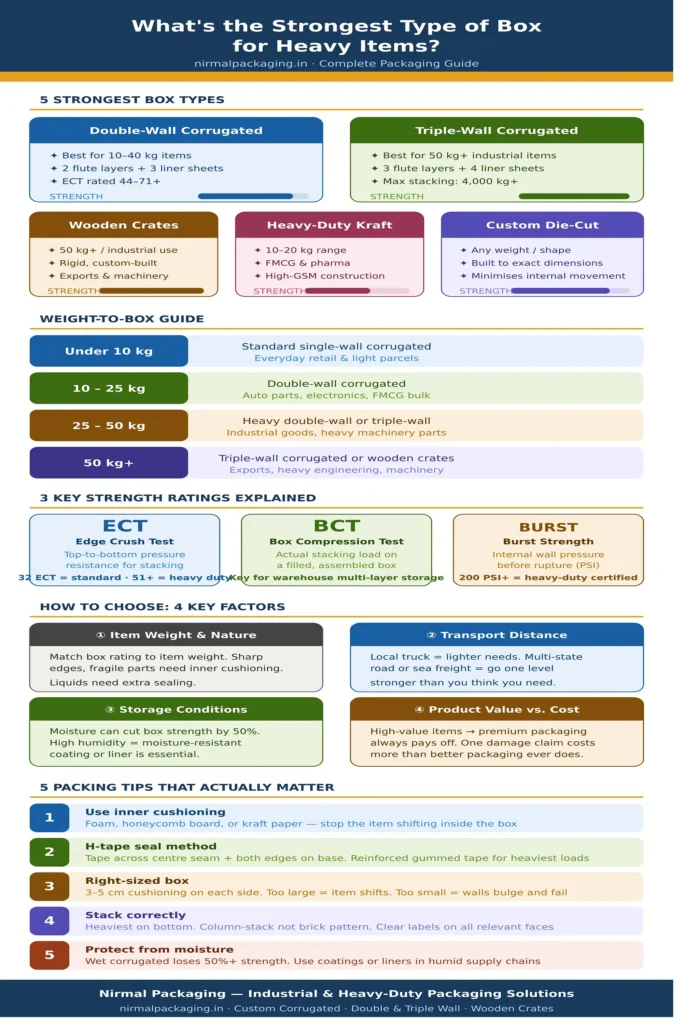
Start With the Weight
This is your baseline. A general rule that holds up well:
• Under 10 kg — standard single-wall corrugated is fine
• 10 to 25 kg — double-wall corrugated is your go-to
• 25 to 50 kg — heavy-duty double-wall, or consider triple-wall depending on value
• 50 kg and above — triple-wall corrugated or wooden crates
These aren’t hard rules — a 25 kg item that’s also fragile and going 1,000 km by road needs more care than a 25 kg item going 50 km in a covered truck. But it’s a starting point.
Think About the Journey, Not Just the Weight
Where is the package going? How is it getting there?
Local delivery in a covered vehicle is very different from a multi-state road journey, which is very different from sea freight. The longer and more complex the journey, the more stress the packaging takes — from vibration, temperature changes, multiple handling points, and stacking.
A good rule of thumb: if you can’t be sure how the package will be handled at every point in its journey, assume the worst and pack accordingly.
Factor in the Storage Conditions
Will these boxes be stored in a warehouse where they’re stacked six-high for weeks? Will they be exposed to monsoon humidity? Will they be in cold storage?
Moisture is one of the biggest enemies of corrugated strength. A box that’s rated for 30 kg dry can lose 50% or more of its strength when it absorbs moisture. If humidity is a factor in your supply chain, you need moisture-resistant coatings or liners — not just a stronger box.
Consider What’s Inside
Sharp edges can puncture box walls from the inside. Liquid or semi-liquid contents need additional sealing. Fragile components need inner packaging — foam, honeycomb board, or moulded inserts — to reduce load on the outer box.
The outer box and the inner packaging work together. A great outer box with no inner support is still going to fail if the item is moving around freely inside.
What the Strength Ratings Actually Mean
When you’re sourcing heavy-duty boxes, you’ll come across some technical terms. Here’s what they actually mean in plain language:
ECT — Edge Crush Test
This measures how much top-to-bottom pressure the box can handle before the walls start to buckle. It’s the most relevant number for stacking situations. A box rated at 32 ECT handles lighter loads; 51 ECT and above is where you’re in heavy-duty territory.
BCT — Box Compression Test
This is the actual compression test on a fully assembled, filled box. It tells you how much stacking weight the box can handle before it fails. Very important for warehouse storage where boxes are stacked multiple layers high.
Burst Strength
This is how much internal pressure the box walls can take before they rupture. Relevant for items under pressure or for boxes that will be tightly compressed in transit.
When you order from a reliable supplier like Nirmal Packaging, these specs are tested and certified — not just printed on a data sheet.
Industries That Rely on Heavy-Duty Packaging Every Day
It’s worth spelling out which sectors actually depend on this kind of packaging, because “heavy items” means different things in different contexts:
Manufacturing and Engineering
Dense metal parts, castings, and precision tools. These items are heavy per unit and often have awkward shapes. Custom corrugated inserts and heavy-duty outer boxes are standard here.
Automobile and Auto Parts
Auto components travel long distances and face a lot of handling. Vibration resistance matters as much as compressive strength. Corrugated with inner cushioning is the industry standard.
E-Commerce
India’s e-commerce growth has created a massive demand for reliable packaging across weight categories. Appliances, gym equipment, furniture flat-packs, bulk orders — these all need heavy-duty solutions that also look good when they arrive.
Agriculture and Food
Bulk grains, processed foods, and agricultural produce need packaging that holds up in humidity and through rough handling at mandi points. Moisture-resistant heavy-duty boxes are essential.
Pharmaceuticals and Chemicals
Safety and regulatory compliance matter here. Packaging needs to be strong enough to prevent damage while also meeting marking and labelling requirements for traceability.
Practical Tips That Make a Real Difference
Even the best box in the world underperforms if you don’t pack and seal it right. A few things that genuinely matter:
Inner Packaging Is Not Optional for Heavy Items
Foam inserts, honeycomb board, bubble wrap, or crumpled kraft paper — whatever reduces the item’s movement inside the box dramatically reduces the stress on the outer walls. Don’t skip this.
Seal Like You Mean It
One strip of tape across the top isn’t enough for heavy items. Use the H-tape method — tape across the centre seam and along both edges — for the base especially. For very heavy shipments, reinforced gummed tape outperforms pressure-sensitive tape.
Right Size Matters More Than You Think
A box that’s too large lets the item shift around, which transfers stress to the walls and corners. A box that’s too small puts the walls under constant outward pressure. Aim for a snug fit with about 3–5 cm of cushioning material on each side.
Label Clearly
“This Side Up,” “Fragile,” “Heavy — Use Mechanical Aid” — these labels only work if they’re actually on the box and readable. Use bold labels on all relevant sides, not just one.
One Last Thing Worth Saying
There’s a tendency to treat packaging as a cost to be minimised. And honestly, I get it — it doesn’t feel like a value-added expense in the way that, say, product development or marketing does.
But here’s the reality: packaging is the last thing standing between your product and damage. It’s what the customer physically interacts with when they receive their order. It affects return rates, customer satisfaction scores, and repeat purchase behaviour more than most businesses track.
Getting packaging right — especially for heavy items — isn’t overcautious. It’s just good business.
If you’re looking for heavy-duty corrugated boxes, industrial packaging solutions, or custom-built packaging for specific products, Nirmal Packaging is a good place to start. They work with businesses across manufacturing, FMCG, pharma, e-commerce, and agriculture — and they understand that no two products have the same packaging needs.
Quick Reference: Strongest Box Types at a Glance
• Double-wall corrugated: Best all-rounder for 10–40 kg items, reliable and cost-effective
• Triple-wall corrugated: For very heavy or high-value goods, long-distance or export shipping
• Wooden crates: For dense industrial items, large machinery, and applications where rigid structure is required
• Heavy-duty kraft: For medium-weight items, FMCG, pharma, retail
• Custom die-cut corrugated: For products with irregular shapes or specific protection needs
Figure out your weight, know your journey, understand the conditions — and choose accordingly. When in doubt, go one level stronger than you think you need. The cost difference is almost always smaller than you expect, and the peace of mind is worth considerably more.